

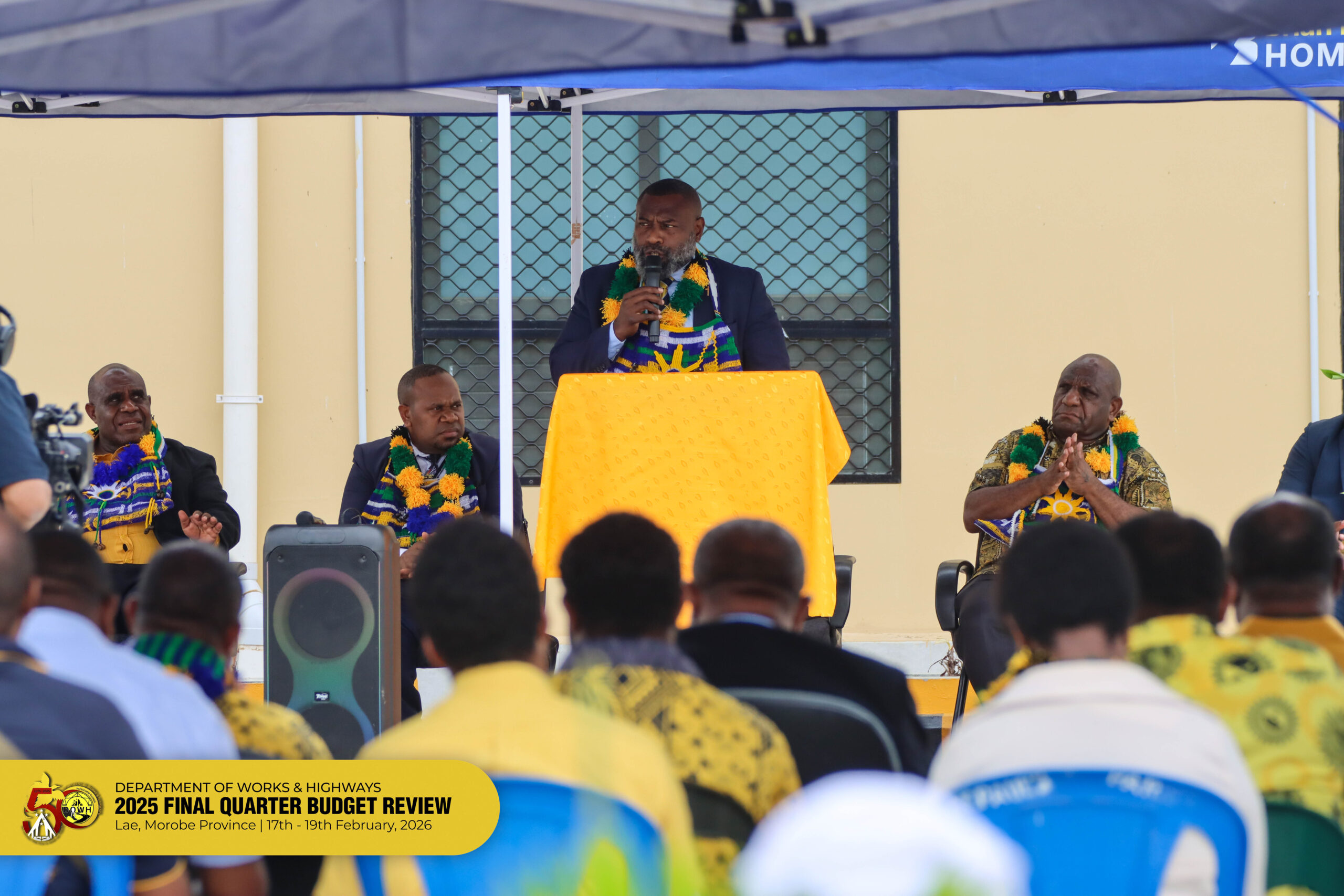
Lae, Morobe – February 17, 2026
The Department of Works and Highways (DoWH) commenced its 2025 Final Quarter Budget Review in Lae on Tuesday 17th February, with a focus on innovation, accountability and dedication to drive the country’s connect PNG and Road Network Agenda.
Minister for Works and Highways and Acting ICT Minister Hon. Peter Tsiamalili Jr. initiated the 3-day Budget review meeting with a call for greater Innovation and accountability in the Department’s operations, extending to all regional and provincial operation offices.
The Minister stated that the review is a turning point for the nation’s infrastructure agenda to “Connect the Unconnected and Reaching the Unreached under ConnectPNG Program and Preserving the Road Network through Sustainable Maintenance”
“It is our Prime Minister’s vision that we improve from the recent 49 years. You are part of the foundational journey to set up the next 50 years of our country,” he declared.
Minister Tsiamalili reiterated the central role of roads and bridges in driving economic growth and national unity.
“Our roads are the lifeline of our education, our health, our livelihood. 2026 must be a year of performance reset. This reset will focus on three pillars: moving from a spending mindset to an output mindset, ensuring systems function beyond individuals, and embracing innovation.”
The Minister commended Works field officers for their resilience in 2025 despite extreme weather, aging infrastructure, and procurement pressures. He pointed to achievements such as the completion of missing links on the Magi Highway, Trans-National Highway, and Tabubil–Telefomin corridor.
He reminded managers that every kina spent must deliver value under the Connect PNG Program and the National Road Network Strategy (NRNS).
“Public resources are entrusted to us through Parliament and Government. The people deserve results, not leakage. We must cut down inflated costs, unnecessary variations, and poor accountability.”
Tsiamalili challenged engineers to adopt climate-resilient designs and smarter maintenance regimes. He also called for the establishment of a Public Works Training and Research Institute to drive applied research and solutions.
“We cannot continue to solve tomorrow’s problems with yesterday’s designs,” he said. “This Department is not about contracts or allowances; it is about service. Our work connects mothers to hospitals, children to schools, and farmers to markets.”
As the Department closes the 2025 financial year, Minister Tsiamalili urged managers to terminate non-performing contracts, blacklist poor contractors, and enter 2026 with renewed accountability.
“Leave a legacy after we exit civil service,” Minister Tsiamalili concluded. “Serve our people with pride and integrity. The future of our infrastructure depends on what we do now.”
The meeting brought together the Department’s leadership, Regional and Provincial Works Managers, and development partners including the World Bank, the Australian Department of Foreign Affairs and Trade, and the Asian Development Bank, Representatives from the Department of Prime Minister, and Department of National Planning and Monitoring,
Department of Works and Highways Secretary Mr Gibson Holemba called for discipline and innovation in managing public funds to deliver effective road works and infrastructure maintenance.
“We must see what is working and what is not working and work within the budget,” Secretary Holemba said.
“Do not carry unsolicited projects in and exhaust our budget. Our job is to preserve our investment. The money that we spend must produce value.”
Holemba emphasized that maintenance must remain the department’s top priority, urging engineers to embrace new technologies and rethink outdated approaches.
“Technology has changed. We need to sit down and think hard about how we work. The focus for us is maintenance first, we must improve the system rather than protect the problem.”