

Port Moresby, Monday 12 January 2026
Prime Minister Hon. James Marape has called on Papua New Guinea’s public servants to take personal and institutional responsibility for driving the nation’s Reset@50 agenda, warning that the country’s next 20 years will determine the future of generations to come.
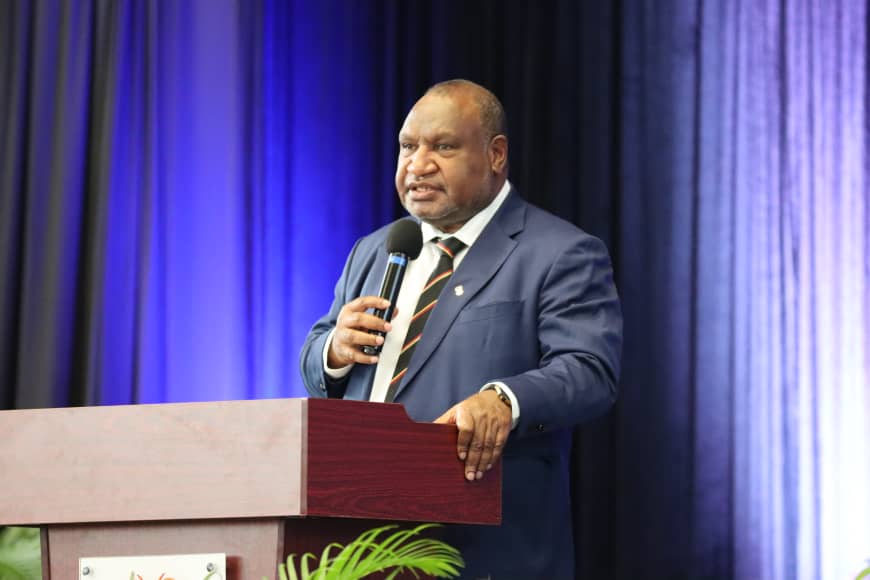
Addressing the 2026 Public Servants Dedication Service at the Sir John Guise Indoor Stadium, Prime Minister Marape said PNG has now stepped beyond its first 50 years of Independence and must enter a new era of discipline, delivery and national renewal.
“This is not a cosmetic exercise. This is about our ethics. It is about how we live and work where we are placed. The next 20 years will determine what kind of country our children inherit,” Prime Minister Marape said.
He said while public servants make up only about 1.3 percent of the population, they account for almost 40 percent of national government expenditure, placing a heavy responsibility on them to deliver maximum value for the people.
“Only about 20 percent of the year is spent at work, yet we consume a very large share of the nation’s resources. That small window of time must be used with discipline, integrity and productivity,” he said.
Prime Minister Marape reaffirmed that the Reset@50 agenda is grounded in values, faith and accountability. “Putting God first is not accidental. It is fundamental to who we are as a nation. Public service is not just a job — it is a moral responsibility,” he said, quoting Matthew 6:33 and Luke 12:48.
He told public servants that government performance will now be judged by delivery, not spending.
“We will no longer be measured by how much money we spend, but by what we actually deliver to our people — in power, water, roads, agriculture, jobs, health, education and economic opportunity,” Prime Minister Marape said.
To support this shift, the Prime Minister announced stronger financial tracking through the National Monitoring and Coordination Authority, working with the Department of the Prime Minister and the Chief Secretary, to ensure government funds are directly linked to results.
“For too long, we have not followed the money to delivery. That must change,” he said.
Prime Minister Marape also pointed to South Korea as a model of what disciplined national effort can achieve.
He noted that in 1953, South Korea emerged from war as one of the poorest countries in the world, with a per-capita income of about US$70, but through long-term national discipline, by 2023 it had become a leading global economy with per-capita income exceeding US$33,000. the next 20 years right, the next 50 will take care of itself.” ENDS “They did not do this by luck. They did it through discipline, focus and commitment across generations. Papua New Guinea now stands at a similar turning point,” he said.
“If we get Prime Minister Marape said today’s generation of public servants will be judged by history on what they leave behind.
“When we retire, will the next generation thank us because we built systems that work, or will they inherit failure?” he asked.
He urged all public servants — appointed and elected — to treat 2026 as a year of renewed dedication, discipline and delivery under the Reset@50 agenda.
“Let us make maximum use of the time we have to build a better Papua New Guinea for our children,” he said.